Making evaluation part of the creative process: introducing Prospero Research

How do we know what difference our work makes? For arts and cultural organisations, this is an essential question. Answering it, however, can be surprisingly difficult.
Good evaluation takes time, money and expertise. Smaller organisations and emerging practitioner groups rarely have a researcher on the team, while commissioning external consultants can absorb resources already stretched across delivery. Knowing which questions to ask, how to gather evidence and what conclusions it supports can feel like another substantial project.
Yet funders increasingly expect organisations to demonstrate impact and value. Quantitative data carries particular weight: how many people participated, how often they attended, what changed. Those figures matter, but so do the experiences behind them. Understanding someone’s growing confidence, changing perspective or sense of belonging requires space for their voice.
We developed Prospero Research to help bring these different forms of evidence together, making evaluation more manageable and more closely connected to creative practice.
Its origins lie in C&T’s work on the Department for Science, Innovation and Technology’s Digital Inclusion Programme. Working with participatory groups in Bootle, Redditch and Gloucester, we needed to gather and understand evidence remotely, across multiple sessions. Prospero Research helped us record attendance, skills acquisition, understanding and participants’ reflections, combining quantitative measures with qualitative responses.
More recently, we used it on Elgar at the Asylum, gathering audience feedback on an interdisciplinary performance exploring Edward Elgar’s time making music at Powick Asylum. These contrasting settings have helped us develop a tool that responds to different kinds of participation.
At its heart is Theory of Change: a way of articulating the difference an organisation hopes to make and how its activities might contribute to that change. Alongside this, logic models connect activities, outputs and outcomes, helping organisations identify what they can meaningfully measure.
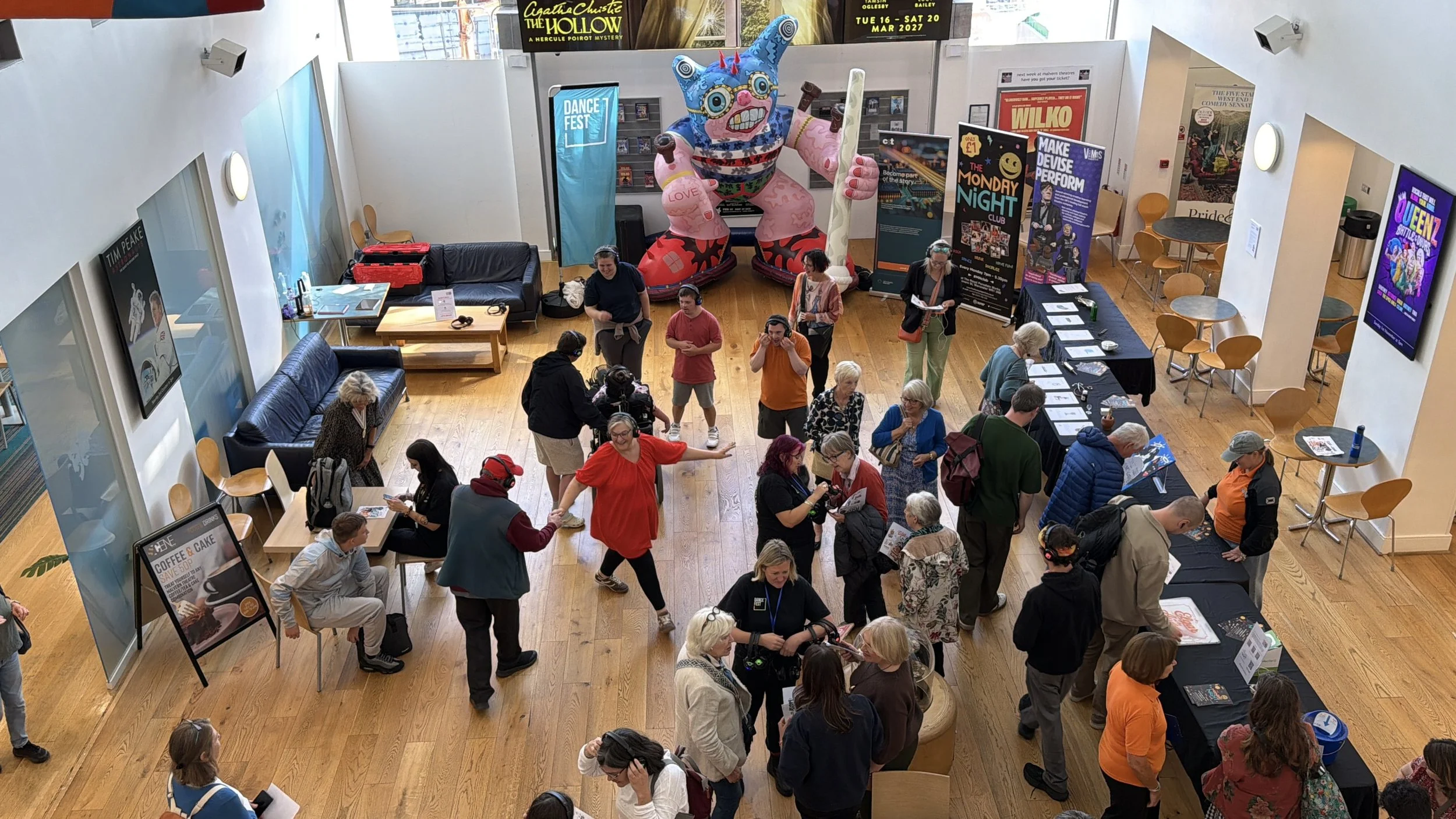
Audiences at Elgar at the Asylum completing the Prospero Research survey
Prospero Research uses these frameworks to help you design an evaluation around your own purpose. AI supports the design process and helps interrogate the evidence collected against your intended outcomes. The aim is to support thoughtful interpretation, while keeping your questions and ambitions at the centre.
You can create a range of “evidence gatherers”: tools for collecting responses through text and audio. These can invite contributions from workshop participants, audiences, practitioners and external stakeholders, bringing different perspectives into a shared evaluation. The system then helps compile and analyse those responses in relation to your Theory of Change.
Having piloted Prospero Research within C&T’s practice, we are now looking for five partner organisations across England, Wales and Scotland to test it through their own projects. We welcome interest from arts and cultural organisations, youth work and education.
A small charge will cover digital delivery costs. Our ambition is to offer a cost-effective way to understand and communicate impact, while learning together about how the system works across different contexts.
Evaluation should help us learn, improve and recognise what matters to the people we work with. We want Prospero Research to make that process easier.
Interested in becoming a pilot partner? Contact Dr Paul Sutton to explore what might be possible.